Most everything here is stolen from the following sources. I am just trying to consolidate the information I acutally use so I can stop having to dig around these pages. Markup Formatting Reference Formatting Reference: Formatting Quick Help MarkupFormatting Reference: Markup Overview
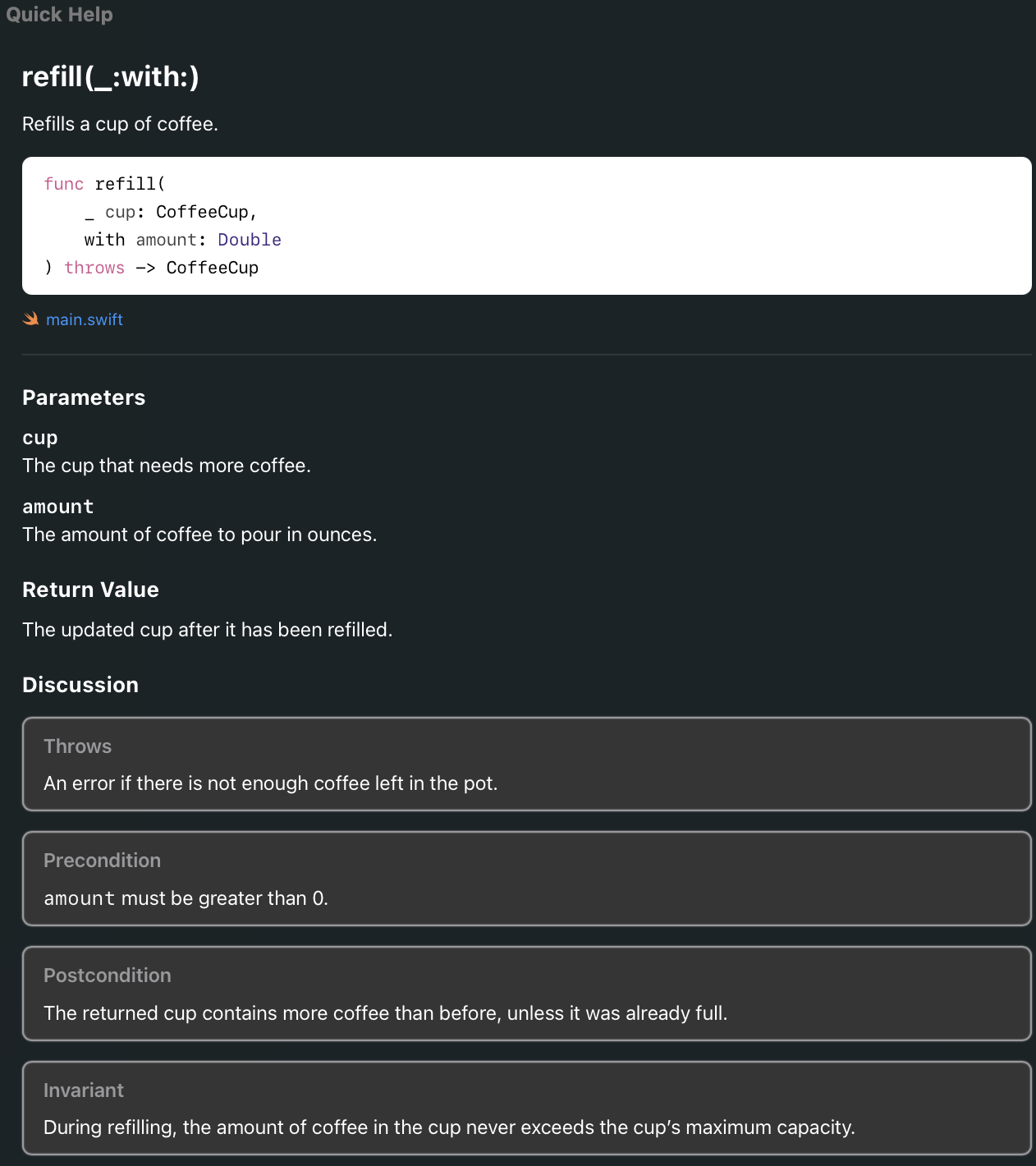
Marking up your functions makes them look profesh inside Xcode. You should know about these three sections:
/**
 Refills a cup of coffee.

 - Parameters:
   - cup: The cup that needs more coffee.
   - amount: The amount of coffee to pour in ounces.
 - Returns: The updated cup after it has been refilled.
 - Throws: An error if there is not enough coffee left in the pot.
 - Precondition: `amount` must be greater than 0.
 - Postcondition: The returned cup contains more coffee than before, unless it was already full.
 - Invariant: During refilling, the amount of coffee in the cup never exceeds the cup’s maximum capacity.

 */
func refill(_ cup: CoffeeCup, with amount: Double) throws -> CoffeeCup {
    precondition(amount > 0, "Amount must be greater than 0.")
    // implementation
}
- cup: will appear as a parameter inside the parameter section along with - amount: .
After the Throws section you can specify a general description as well as call outs that
will appear inside that description.
And then you put it all together and it looks a little something like this
Inside a comment you can use the following syntax which results in formatted Quick Help.
    * | + | - Attention: description
    optional continuation of description
G
If you don't want to have to type out all of this manually every time you can take advantage of snippets in xcode. Here is a really detailed one I came up.
I assigned this snippet to doc so when I type that in Xcode it automatically inserts this massive block and lets me tab
through the different sections.
  /**
 <#What this does, why it exists, and any important context a reader should know.#>

 - Parameters:
   - <#param1#>: <#What this parameter represents.#>
   - <#param2#>: <#What this parameter represents.#>

 - Returns:
   <#What value or effect this produces.#>

 - Invariant:
   <#What always remains true, if applicable.#>

 - Precondition:
   <#What must be true before use, if applicable.#>

 - Postcondition:
   <#What is guaranteed after use, if applicable.#>

 - Note:
   <#Any non-obvious design choice, caveat, or implementation detail.#>

 - See Also:
   <#Related symbol, if useful.#>
 */
Shorter version bound to dsh
/**
 <#What this does and why it exists.#>
 */
For Variables bound to dvr
 /**
 <#What this property represents and why it exists.#>
 - Invariant:
   <#What is always true about this property, if applicable.#>
 */
For Todo items bound to tos
// TODO: <#What still needs to be done.#>
For longer Todo itmes bound to tom
/**
 - TODO: <#What still needs to be done.#>
   <#Optional continuation with more detail, constraints, or context.#>
 */
Attention Author Authors Bug Complexity Copyright Custom Callout Date Example Experiment Important Invariant Note Precondition Postcondition Remark Requires See Also Since Version Warning